America appears under-policed compared to European countries, which have more police per capita:
France has a higher police-to-population ratio than the United States. France averages roughly 330 to 452 police officers per 100,000 residents (depending on whether specialized paramilitary forces like the Gendarmerie are included), whereas the US averages about 210 to 220 sworn officers per 100,000 residents.
And shown below:

This would seem to indicate a failure of American policing or an inattentiveness towards crime. But such apples-to-apples comparisons are non that useful. Police are not homogenous, nor are populations. Without controlling for key variables such as recidivism and deterrence–but also demographic and cultural differences–it’s unfounded to say America’s style of policing is sub-optimal compared to other countries that have more police per capita but different demographics. America having fewer police per capita is negated by better-armed police, longer sentences, better crime-solving ability, and deterrence. That is, given these variables, American policing ‘works’ compared to the alternative of adopting a foreign style of policing.
Also, America has far more private security than Europe. Europe’s unarmed police are the equivalent of an unarmed American private security guard. By comparison, America’s armed police are more like the equivalent of Europe’s military police. The European equivalent of “police,” especially in much of continental Europe, is some overweight middle-aged guy wearing a reflector vest and carrying a walkie-talkie–not exactly the kind of presence that would deter America’s more hardened and violent criminals. As we can see, these comparisons fall apart unless we account for obvious confounders, such as whether officers are armed.
It’s also hard to establish causality. Do countries have more police because they are safer, or because they face greater threats such as political violence, terrorism, or war? Countries that rank high in police per capita often have serious economic or political problems. Palestine, for example, ranks fourth globally, with 1,483 police officers per 100,000 residents, yet I would hardly consider it a model of stability or public safety.
Additionally, the US has the FBI and other powerful federal agencies, which have more resources compared to local police departments and can assist in solving complicated cases. Such agencies have unlimited resources for solving crimes–not just domestically, but crimes that affect American interests abroad, like organized crime or terrorism. Sure, there is Europol, but it’s much more limited compared to the FBI and has no arrest powers. At best it can assist in investigations, but such investigations are almost always spearheaded by the FBI.
A common criticism is that America’s police have become militarized, but this is also why fewer police may be needed. If each cop is packing more firepower, body armor, and equipment, it stands to reason fewer police will be needed. Secondly, intimidating police are a good deterrent, or at least compared to physically smaller, unarmed cops like in other countries. This is why bouncers are selected to appear physically intimidating even if they do not actually physically bounce patrons from bars.
Steve Sailer in a Substack post asks “Why can’t we have better cops?” Both sides of the aisle seem to be in agreement that better policing is needed and that if police were better paid, then they’d be more effective at their jobs and de-escalating encounters, resulting in fewer deaths at the hands of the police and the public having a higher trust in the police, as well as lower crime.
I take a differing view. Policing is probably one of the few exceptions where higher quality is not always better, or where suboptimal quality can sometimes produce better outcomes by deterring crime. Criminals may be more deterred by police who are perceived as overreacting or trigger-happy, than by officers who are more intelligent or analytical. Historically, this was often the case. Those with leadership qualities became soldiers or generals, whereas those who were simply tough, but lacked those other qualities, became police. Of course, you need smarter police to investigate and solve crimes, but as a deterrent, intelligence alone is not necessarily an advantage.
The French police and their baguette nightsticks or the British police and their Marge Simpson-hairdo hats does not instill the same sort of fear or compliance compared to well-armed, muscled American police. The expectation in America when the cops are called is that someone who is armed and ready face off against a potentially dangerous assailant will arrive, with backup if necessary, not the guy with a walkie-talkie and only a safety vest for protection.
Even the type of ammunition is chosen for maximum stopping power: so-called hollow-point bullets, which expand on impact, increasing the likelihood of rapidly incapacitating a target while reducing the risk of exiting bullets hurting bystanders. Officers are trained to aim for the torso, since it is the largest target and the most effective way to stop an imminent threat–not to fire warning shots. The point is, American police possess a level of firepower that is often absent in much of the rest of the Western world. Hence, fewer police needed.
Also, one must take into account demographics. It’s also not so much that America’s police are exceptionally bad, but that they have to contend with uniquely bad demographics. If you look at America’s worst prisons or those who are serving life sentences for violent crimes, there are not a whole lot of Japanese people in there. America’s style of policing is militarized, in part because America’s demographics are unusually militant by Western standards, being well-armed and liable to mood swings and instability due to widespread drug and alcohol use, which are the last things you want from a suspect who may also be armed. So police have to act on the assumption that they may face retaliatory firepower, especially in bad neighborhoods. Or ornery suspects under the influence who may not comply readily with simple commands.
I have also heard the argument that Europe having more police helps deter shoplifting and other low-level crimes. This is a popular argument, and it makes sense on the surface: more police increases the likelihood of being caught, which matters more than the severity of the punishment.

But again, the evidence doesn’t bear this out. Western Europe has much more shoplifting than even the poster child of shoplifting, San Francisco, with more habitual offenders. From The Guardian, 2023 was the worst year on record for shoplifting:
According to the Office for National Statistics, 2023 was the worst year on record for shoplifting, with more than 430,000 cases recorded, an increase of more than a third from the year before. But that is probably just a fraction of the real number. The British Retail Consortium – the body representing almost all of the major retail chains, incorporating food and drink, fashion, DIY, health and beauty and more – recently reported that incidents of customer theft more than doubled from 8m to 16.7m in the period between 1 September 2022 and 31 August 2023. Losses reached £1.8bn, up from £950m the year before.
There is also the possibility that shoplifting in the UK is limited not by more policing, but by stores carrying less merchandise or reducing inventory in response to theft. It’s reasonable to assume that poorer countries have stores with fewer goods on display and less valuable merchandise to steal. Shoplifting in a poorer country may simply offer a smaller potential payoff than it does in the United States, making it less worthwhile. Once again, this illustrates how difficult it is to generalize from one country to another without accounting for these underlying differences.
From what I gathered online, in the UK, thefts tend to not be referred for prosecution, because nothing will happen. Rather, it’s up to the shopkeeper to ban offenders from the store. In America, conversely, Walmart has an unstated policy of always calling the police for theft, no matter how small. This can strain policing resources, but I would reckon it’s much more effective as a deterrent than leaving it up to stores to “ban” the customer, as in the UK.
Also, longer sentences mean fewer police may be needed, as criminals are kept off the streets. The US criminal justice system is known for having harsh recidivism laws, such as three-strikes laws. In the UK, however, it’s not uncommon to read stories of people being caught shoplifting or committing felonies repeatedly, way more times than in the US. Hence, San Francisco’s post-Covid shoplifting surge is not so much attributable to ineffective policing, but rather the failure of prosecutors to prosecute small thefts, which is orthogonal to policing. But still, one must take into account that the theft situation is still likely worse in other countries, not only due to under-policing, but weaker recidivism laws and shorter sentencing.
One can argue that this does not change the fact that America is under-policed. Yes, America would have less crime if there were more police, all else being equal. But the claim is that other countries have better policing, so to take this at face value, if police were swapped crime should go down, but I don’t think it would. The existence of widespread retail theft in the US does not mean American-style policing is ineffective; it would be even worse under European-style policing. We saw in 2020 during the BLM/antifa riots and looting the consequences of passive policing. Just having more police per capita won’t do anything if they are unarmed and stand-down.
If police were swapped, property crime, bank robberies, and homicides would certainly surge in the US, especially for certain high-risk groups and cities, reversing the multi-decade trend of falling crime rates since the early ’90s. In the eighties and nineties there was an epidemic of armed bank robberies in Los Angeles. Such robbers were recruited by gangs, and their modus operandi was to go for the vaults, as opposed to passing a note, so the losses were substantial, which combined with media attention of the amounts stolen led to copycat robbers. Better-armed and trained police and stiffer sentencing saw bank robberies peak and subside by 1997. Conversely, under such an officer swap, crime outside of the US would fall; the UK would have fewer muggings for example.
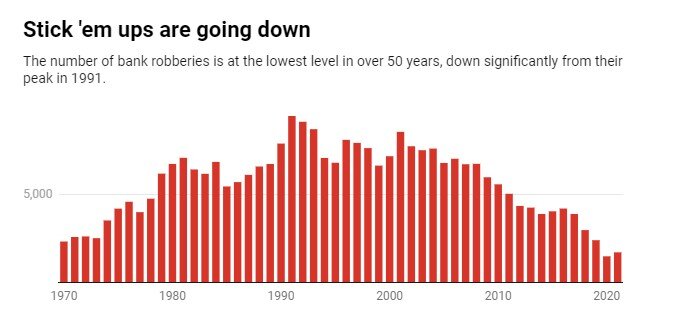
If demographics were swapped, crime would plunge in the US, and police would not need to be as militarized. Japan however would have a crime wave of the likes never before seen, both violent crime but also white-collar crime. Its futuristic electronics stores would be stripped to the drywall. Same for Norway: its famously lenient criminal justice system and gun-less policing would also prove woefully inadequate. Professional shoplifter gangs or Apple-Store-looters are not going to be deterred by European-style policing.
What about white collar crime and long sentences for organized crime? Here, again, I think America’s approach of long sentences is optimal compared to shorter sentencing. The common criticism I read is that a higher certainty of being caught is a better deterrent compared to a long sentence. Long sentences work, not so much at preventing people from entering into crime, but at solving it. A criminal enterprise usually involves a lot of people. Inevitably someone messes up and gets caught. Staring down the barrel of a long sentence, he does the rational thing and defects; the entire enterprise soon crumbles.
There is a reason Kim Dotcom, Julian Assange and Edward Snowden fought tooth and nail to avoid extradition to the US, including years of drawn-out legal battles and nation-hopping; no one doles out punishment like America does.
In quasi-socialist or weak economies, short sentences and lenient policing perhaps works better, as the economic incentives to commit complicated crime are not that great when there is not much money to go around anyway. The South American drug cartels of the ’80s became wealthy because Americans were buying the drugs. In wealthy societies like the US or China, it’s the opposite. A bigger and richer economy and consumers with a lot of disposable income makes the returns to crime far greater assuming the criminal does not get caught, hence the need for harsh punishments to reduce the expected value of crime by imposing a serious potential downside.
Academics and journalists often portray Europe’s criminal justice system as a model for the world. But this drifts into wishful thinking by ignoring a basic economic principle: people respond to incentives. There have been several recent notable large-scale business scandals in Germany–the Volkswagen emissions scandal and Wirecard–and fraud may be endemic to top German firms, so evidently shorter sentences and a more lenient criminal justice system hasn’t helped. When the cost of criminal behavior increases–through stronger enforcement or longer sentences–it is reasonable to expect some deterrent effect. Conversely, reducing sentences or making prisons more humane may have benefits, but they are not a magic solution to crime, as the evidence above suggests.
Overall, European countries differ from the United States in countless ways: demographics, geography, population density, and cultural attitudes toward crime. America has unfavorable demographics and low social trust, necessitating better-armed police and longer sentencing, which compensates for having fewer police. A system that works in one country may not translate directly to another. The question is not whether America should become more like Europe, but which policies actually work within America’s unique demographic and cultural environment.