Taleb is having another one about IQ:
Incorrect, @Grok mon ami.
IQ doesn't measure "intelligence" because the test is made by idiots who don't know how intelligence works, & limit it to a narrow class of mental operations, not because of "other factors".
It works for low levels because ANY test would work there. https://t.co/1d3TU7r69d— Nassim Nicholas Taleb (@nntaleb) February 25, 2026
Taleb is being obtuse and cannot confront the fact that his own IQ is likely not that high. The topic of IQ forces him to confront his own intellectual mediocrity.
Those “narrow class of mental operations” happen to also be highly predictive of success at a broad range of operations–that is how ‘g’ works. The idea is that success at some tasks is highly predictive at a wide range of others. This is why tech and finance companies screen so aggressively for signifiers of high IQ–be it advanced degrees, phone interviews, etc.–because obviously intelligence does signify something at the high-end, not just the low-end as Taleb erroneously assumes. Prestious, high-paying companies pay a large premium for smart employees. If Google could hire average-IQ workers at minimum wage to do those SWE jobs, they would be remiss not to.
It also goes back to my point about individual preferences: let’s assume one aspires to a career that pays a lot of money (e.g. law, finance, tech etc.). You’re going to be competing with other smart, ambitious people for those relatively scarce jobs and positions (e.g. graduate school, undergrad, etc.)–hence IQ matters, even if it’s not directly applicable to the job.
To get into top schools–and to stand out among the many other smart, ambitious applicants–you need strong and objective signals of exceptional ability: high placements in math competitions, top GRE or SAT scores, and similar distinctions of a competitive, rank-ordered nature. As mentioned earlier, simply taking calculus in high school, completing AP courses, or even participating in summer research programs has become pedestrian. These once-impressive achievements are now common among competitive applicants. So there is no getting around the IQ matter.
Charles Murray also writes:
If Crémiuex's assertion about college degrees being less cognitively stratified seems improbable ("But in 1910, only affluent kids went to college and most smart-but-poor kids did not"), you have to distinguish between the system's success in getting smart kids into college and… https://t.co/l6VUJ0YxDV
— Charles Murray (@charlesmurray) February 24, 2026
1910 is a really long time ago. I’m not sure how well the ‘college experience’ in 1910 maps to today. I think the situation is more like, the typical college grad was smarter in the early 1900s due to selection effects; I don’t dispute this. But today, the completion of college has become a more useful signifier or predictor of competence vs the 1900s despite a lower mean IQ of today’s graduates. This is due to accreditation and uniform standards, which didn’t exist for the first half of 1900s.
The GI bill in 1952 and the Higher Education Act of 1965, saw the growing popularity of college for the masses and the subsequent establishment of uniform standards. Before then, colleges had considerable discretion as to the course material and difficulty. So from the perspective of employers, a degree has become a more relaible signifier of competence even if the median graduate is less intelligent. Even then, I don’t think the IQ gap between graduates today, vs the early to mid 1900s is that great–maybe 10-15 points at most. So that would imply something like an average IQ of 115 among graduates in the early to mid-1900s, compared with roughly 105–110 today. But this negated by accreditation, so employers still get the useful signal.
The implied claim that college was hader back then is also disputable. College in the early 1900s didn’t have those long senior dissertations and huge problem sets as seen for today’s graduates. As some accounts on Quora suggest, college in the early 1900s functioned more as a finishing school or residential enclave for elites, than enforcing any semblance of rigorous academic standards.

A favorite example I like to give to contrast the 1900s to today is JFK’s laughable Harvard application essay, which reads as if a 6th grader wrote it, but evidently was good enough for him to be admitted in 1935:
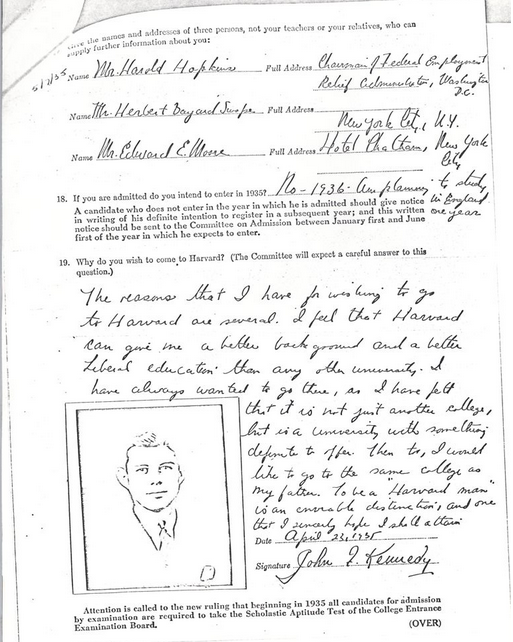
Before dismissing this as favoritism stemming from his father’s wealth, it’s worth noting that his essay filled the space allotted on the application form. It was not expected of applicants to write long, polished essays.