I saw this viral post by Matt Walsh deploring the use of AI in writing:
The number of people who clearly use AI to craft basic posts on this site, and replies to posts, is pretty shocking. Once you learn how to spot AI writing, you see it absolutely everywhere on here. It’s unmistakable. The tech has existed for 10 seconds and already huge swaths of…
— Matt Walsh (@MattWalshBlog) March 15, 2026
AI has no mind, no essence, and no emotion, so it struggles with this. The problem is that conversational writing is a skill. Some people have a natural talent for it, some people don’t, but you have to do it to get better at it. Pretty soon we will live in a society (maybe we already do) populated by people who are technically literate but simply do not know how to express their thoughts and feelings in writing. How could even the most avowed AI enthusiast fail to see why this is a bad thing?
Some may be surprised to learn that verbal IQ is more ‘g loaded’ than even math:
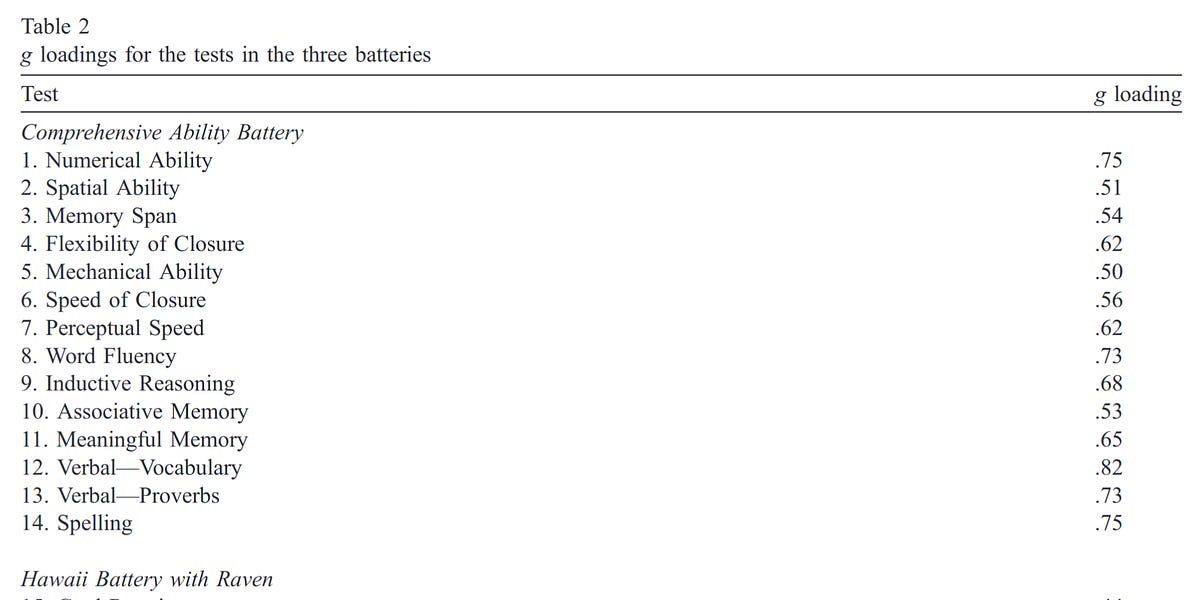
So imagine how some people struggle at math, or on the other extreme, excel at math, and now imagine even more interindividual variance or disparity as it pertains to writing. I’m sure we all know people who seem to grasp math concepts effortlessly or who placed well in math competitions, and others who never seem to clear the conceptual impasses. Or for sports, growing up, how some people are just naturally ‘good’ by being faster, bigger, or better hand-eye coordination? Why would writing be any exception?
Not to mention, as I argue in “Math vs Writing: difficulty and threshold effects,” the difficulty of writing can be explained by how the IQ threshold to become competent at writing, is possibly higher compared to being competent or proficient at math. This can explain the apparent rarity of good writers compared to ‘STEM people’ who are otherwise a dime a dozen on Twitter it seems. Or why podcasters greatly outnumber writers. The ‘heath’ or ‘business’ categories of podcasting has thousands of entries alone.
Taken at face value, if we assume that writing is a skill–and that, like all skills, some people are much better at it than others–then what is wrong with using AI if it helps people become better at said skill? This is like berating a nearsighted person for wearing glasses instead of ‘learning to see better,’ which of course when framed that way is unnecessarily cruel or nonsensical. Given how g-loaded writing ability is, this is tantamount to asking someone to become smarter, which goes against everything known about IQ.
But can’t people improve at writing with practice? Yes, but surprisingly little. Even with years of schooling and college, the majority of people struggle to write well, let alone with any sense of style. Just look for what passes for writing on LinkedIn (so-called ‘LinkedIn slop‘). These are people with successful careers and who do a lot of writing such as emails or ‘business briefs’, yet are still bad at writing. This suggests that not only is writing ability highly unequally distributed, but also innate, similar to other aspects of IQ given how impervious it is to practice. For many of these people, AI isn’t just a crutch for the lazy, but necessary.
Regarding the claim that AI writing is obvious or worse–this is dubious. The fact that so much effort is invested in trying to detect it, suggests its not as simple or obvious as assumed. People may have suspicions that writing is AI generated, but it’s hard to pinpoint why. Some have described it as wordy or dull, but the same can be said for plenty of human writing. More or less, for a non-discriminating audience, AI writing seems to be passable or ‘good enough’. Sure, it may not be great writing, but the point about talent still stands: it’s no different from how only a small number of people can realistically aspire, to, say, play basketball as a career no matter how hard they practice at it.
Part of the disconnect between the perceived difficulty of writing and its actual difficulty, is that writing is deceptively hard. Because writing and speech both involve words, people wrongly assume that the former follows from the latter–that competency at writing is a natural consequence of being good at talking. Or that the two are interchangeable. But whereas speech is innate, discouragingly, there is nothing inherently natural about writing, just as arithmetic does not naturally follow from the ability to count (or to otherwise visually appraise quantity). Writing requires precision, with rules and structure, whereas speech is more improvised.
The usual ‘ums’, ‘ahs’ and other filler, are part and parcel to speech. But for writing, the equivalent of such filler is much more intolerable or irritating to the reader. As I have observed, listeners, such as the audience of a podcast, have much more patience for filler in the context of speech, versus readers in the context of writing. The latter are much more likely to bail at the first sign of boredom or confusion, whereas with a podcast, the audience will listen in rapt attention as the guest or host ramble or digress.
The same is true of movies: having already paid, audiences will endure contrived dialogue and predictable pacing in the hope the film redeems itself in the final act. Readers, however, are far more likely to hit the back button long before that point. Writers therefore have to get it right from the outset, so as to not waste the reader’s time. Given how little margin for error writing has compared to other mediums, writers need all the help they can get. Hence, AI if the alternatives are no writing or bad writing.